Not to waste any time, I will not be asking you the usual questions about your career because the answers are already well known. Let me start a little bit differently: What kind of repertoire suites you most in the present time? Has it changed substantially as compared to your career beginnings?
The repertoire that best suits me currently seems to be the early and middle Verdi roles such as Riccardo in Un ballo in maschera and Don Carlo. Also good for my voice are the Verdi tenor roles of I due Foscari, Simon Boccanegra and Attila. My repertoire has evolved and expanded from the time when I started my career. I began earlier in my career singing more Mozart and bel canto roles of Rossini, Donizetti and Bellini. Today I continue to perform Mozart operas, for example, Idomeneo, La clemenza di Tito, and Don Giovanni. Right now Rodolfo in La boheme also continues to be a good fit. I have always stayed true throughout my career to the nature of my voice as a lyric tenor, yet I have developed and explored my capacities on different ends of that categorical spectrum.

What direction will your voice take according to you? Are there any specific operatic roles that you would like to undertake when the right time comes?
I feel very comfortable and healthy with the current state of my voice and in my repertoire, and hope to continue in this direction. I remain healthy, energetic and enthusiastic, but with all the great lessons and experiences I have learned from my career so far. Now I feel secure in the context of my current repertoire, but I enjoy expanding it when I can, and exploring new roles. Already this year I have added two important and fascinating parts that I will continue to perform-Jacobo in I due Foscari and Faust in Boito’s Mefistofele. Perhaps in the next few years I will also include the roles of Cavaradossi in Tosca and Manrico in Il trovatore.
I recall having read your own honest account of the vocal crisis that had troubled you at the onset of your career. What were the reasons for it – from your point of view now, many years later?
As many young singers of the past and present, the development of the voice can be a long process and somewhat of a mystery. For me, I have been singing all my life, since I was a child in the choir of the basilica. I had a very strong natural instinct to sing. When I was a little older, I felt the typical pressures and tensions of a young musician trying to make a career as an opera singer, and temporarily strayed away from my natural tendencies. Luckily, I found a friend and teacher that was complimentary to my needs at the right moment in my development who could help guide me, and I was able to emerge successfully with the foundation that I needed.
How would you assess your own singing currently? When you take a look back, are you able to do it objectively enough? Do you use recordings of your own performances to analyze them later, like many colleagues of yours do?
I am generally satisfied with the status of my singing currently, however I am always trying to refine and improve what I am doing. I am happy with the longevity of my voice and I think that is because I have respected its natural tendencies. As an opera singer, I consider myself a vocalist, and as such, I am always looking for new means of expression by continuing to revisit the markings and directions of the scores, in order to be objective, to answer your question. I try to keep my voice as healthy as I can in order to be able to perform what is asked of me by the composer, and at the same time, keep a sense of freedom and naturalness in the voice. I like to use recordings occasionally as a tool, but not always.
Marketing promotion as part of the singers‘ success is discussed more than ever these days. How important is it for your own career?
Marketing promotion is important, and can be a great ally of the music and the career. The problem is when the career is based on superficial marketing alone. If it is not supported by the real quality of the artist, the marketing could create confusion with the public. That impedes them from creating a real opinion for themselves.
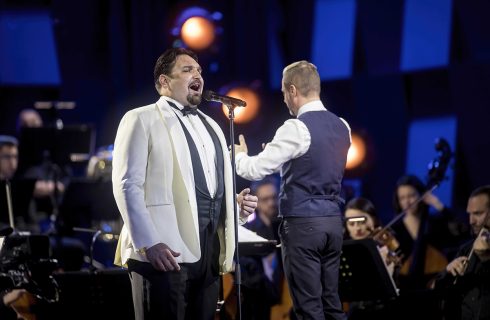
You frequently perform in concerts. How many details of the individual performances “get stored in your memory?“ For example, can you still recall the atmosphere and surroundings of your only concert in Prague so far from six years ago?
The memories of my concerts still exist for me, especially when something extraordinary happens, for better or for worse. Normally the mediocre things are easy to forget. I recollect my concert in Prague years ago- it was incredible, and still stays in my memory as something really extraordinary. The reception of the public and the press was great.
You were born to a large family and have 10 siblings, if I am not mistaken. How often do you get a chance to see them since your work involves constant travelling around the globe?
Although I constantly travel, I always set aside a few weeks every summer to spend in my home of Mexico. That is really my only vacation time of the year, and I find it most important to spend this time with my family and children.
Your involvement with charity organizations and various nonprofit foundations is well known. Would you bring us up to date with regard to your latest projects?
For my foundation, the Eduardo Vargas Memorial Fund, the latest project will be a fund raising concert in the St. Mark’s Square in Venice this July. It is still in its early planning stages. Also later this year will be an additional fund raising concert in Campeche, Mexico.
Do still still play chess as your hobby? Is there anybody among your colleagues with whom you would play it once in a while? What other leisure activities – next to the world of opera and singing – interest you ?
Although I love chess, in the past few years I have not been playing as much. It takes a lot of energy and thinking, and can become rather all-encompassing. Lately I prefer to play lighter games, but ones that still require some intellect, such as Monopoly with my children, and dominoes and cards with my friends and family.
Thank you for the interview and good luck.